Floodlights are simple in purpose but varied in design and application. A one‑size‑fits‑all approach rarely delivers the right light quality and efficiency to make it a suitable purchase, so if you’re looking for floodlights to protect your home or property, you’ve come to the right place.
In this guide, we’ll cover everything you need to know about floodlights, and give our top recommendations. Keep reading to learn more…
What is a floodlight?
A floodlight is a broad‑beam, high‑intensity fitting built to light a large area evenly.
Rather than throwing a narrow shaft of light, it spreads illumination across a wide arc so paths, yards, car parks, and building facades become clearly visible from a distance.
Though it shares a vague naming similarity with a spotlight, the differences are vast. A spotlight concentrates light into a tight beam for highlighting a single feature, whereas a floodlight trades focus for coverage. That makes floodlights the go‑to choice where you need consistent, usable light over an expanse rather than dramatic accents.
Compared with softer ambient fixtures, floodlights are brighter and more directional. They’re not meant to create gentle mood lighting but to deliver usable lux levels for safety, security and task performance, so optics, beam angle and mounting height matter as much as raw wattage.
What are the different types of floodlight?
Floodlights come in several variants, each suited to a particular role:
Residential floodlights
Residential LED floodlights are compact, weatherproof fittings designed for driveways, patios, garden paths and doorways.
They’re usually low to mid‑power LEDs with integrated controls such as a photocell or PIR sensor and simple wall brackets for quick aiming.
The focus is on practical light that aids movement and increases domestic security, so a good balance of lumen output, beam angle, and a warmer colour temperature often works best.
Installation tends to be straightforward. A single, well‑placed fitting will cover a driveway or entrance, while a few modest fittings sited to overlap slightly give even coverage for larger gardens.
Quality matters more than headline wattage, so look for clear lumen figures, decent ingress protection and a fitting that can be aimed after installation.
At Lyco, we have a wide range of residential floodlights, that you can find here.
Professional floodlights
Professional floodlights tend to be a step-up in output, thermal management and control options for commercial and industrial settings.
These are the durable fixtures you’ll find lighting car parks, building facades, loading bays and external work areas. They typically have higher lumen outputs, metal housings for heat dissipation, replaceable drivers and options for trunnion or pole mounting.
Performance characteristics such as lumen maintenance (L70/L90), driver IP class, surge protection and warranty length become important at this level because failures interrupt business and carry higher repair costs.
They also support dimming protocols or networked controls that feed into a building management system, allowing staged lighting, energy optimisation and simpler maintenance planning across multiple units.
Shop the professional floodlight range at Lyco today.
Sensor floodlights
Sensor floodlights are designed for responsive security and energy efficiency.
They combine a floodlight with passive infrared (PIR), microwave or hybrid sensors, so that the fitting only runs when activity is detected.
For home use, a PIR‑equipped light by the back door or over the garage will usually suffice, whereas for larger sites, microwave or combined sensors reduce blind spots and false triggers.
The key points with sensor floodlights are sensor coverage, detection angle, and adjustable time delays. Correctly sited sensors avoid unwanted activations from passing cars, trees, or wildlife.
Modern sensor floodlights are often LED and may also include a low‑level dusk‑to‑dawn mode for occasional ambient light, giving a balance between constant illumination and purely reactive operation.
At Lyco, we have plenty of sensor floodlight options that you can view here.
Solar floodlights
Solar floodlights are ideal where running cable is impractical, such as garden features, remote gates, temporary sites, or locations where a quick installation is needed.
Modern solar units use photovoltaic panels with lithium batteries and LEDs. Their performance depends heavily on panel size, battery capacity and expected autonomy rather than simply wattage.
As a result, winter performance and shading are the usual constraints for solar panels. For best results, position panels with a clear southerly aspect where possible.
Solar is excellent for low‑to‑medium power needs and flexibility, but it won’t always match the continuous output of a mains‑fed commercial fitting. If you’re looking for garden floodlights, solar is a great option.
Shop the Lyco solar floodlight collection here.
What to consider when choosing a floodlight
Buying the right floodlight starts with understanding a handful of specs that actually affect how the light performs in the real world. Let’s break down the key elements you need to know about:
Wattage and lumens
The first things to consider are wattage and lumens.
Wattage is a measure of power, not brightness. Lumens measure light output and are the better indicator of how bright a fitting will appear.
Two fittings with the same wattage can have very different lumen outputs, depending on efficiency, so when comparing products, look for lumens per watt (lm/W). Higher figures mean more light for less energy – a win-win.
Colour temperature and CRI
Colour temperature is expressed in kelvin (K), and affects the type of light you will receive.
Warm light (around 2,700–3,000K) feels cosy and flattering to brickwork and gardens, whereas cool white (4,000–6,000K) is clearer and often preferred for security and commercial uses because it improves contrast.
The other colour-related consideration is CRI. CRI, or colour rendering index, tells you how accurately colours appear under the light.
For general external lighting, a CRI of 70–80 is usually acceptable, but where colour accuracy matters (such as on facades, or product displays), you should aim for 80+.
Beam angle and optics
Beam angle determines how the light spreads.
Narrow beams (in the range of 15–30°) create a focused shaft that is useful for accenting architectural features or for long‑throw sports lighting.
Wider beams (between 60–120°) cover broad areas and are commonly used for car parks and communal spaces.
Optics, reflectors, and lenses control distribution. Quality optics reduce wastage and help avoid light spill into unwanted areas, such as neighbours’ gardens.
When in doubt, think about the beam at the height you’ll mount the fitting. A narrow beam from high up can give similar ground coverage to a wide beam mounted low.
IP rating
The IP rating describes how well the light is protected against dust and moisture.
For most external floodlighting, IP65 is the minimum to aim for. IP66 or IP67 is better for exposed coastal sites or where pressure washing is likely.
How to position your floodlights
Before you start shopping, you need to decide where each floodlight will go.
That first decision shapes everything, from the height and angle you mount a fitting at, the beam you need, and even the physical size of the unit you can use.
Start by taking a walk around the site at the time you most need light, and note the doorways, gates, steps and any corners that need some illumination. Take a note of obstacles such as windows, gutters and downpipes as these often dictate the only practical mounting points.
Size and mounting height matter more than most people expect. A high‑mounted light throws further but needs a narrower beam to avoid wasting light or annoying neighbours, whereas a low‑mounted light gives a wide wash but won’t reach far.
Think about what each light must achieve. Is it a short run of path that needs good, even illumination, or a wide driveway that needs long‑throw coverage? Measure the span you want lit and choose a fitting with the appropriate lumen output and beam angle for that distance.
Floodlights vary hugely in output, so match output to the task. The following table is a rough guide to help you visualise typical pairings of LED wattage, lumen output and the sort of area they cover:
| LED wattage | Typical lumens | Approx area covered | Ideal for |
| 5W | 400 lm | 5 m × 5 m | Entrance |
| 10W | 750 lm | 10 m × 10 m | Small patio |
| 20W | 1,500 lm | 15 m × 15 m | Driveway |
| 30W | 2,200 lm | 20 m × 20 m | Small garden |
| 50W | 4,000 lm | 30 m × 30 m | Medium garden |
| 100W | 8,000 lm | 50 m × 50 m | Large garden |
| 150W | 16,000 lm | 75 m × 75 m | Car park |
Use this as a starting point rather than a rule. Mounting height, beam angle, reflectors, and the finish of surrounding surfaces (light walls reflect more than dark ones) will all change the result.
Where possible, aim lights slightly downwards and use an adjustable bracket so you can tweak aiming after installation. If a PIR sensor keeps tripping, try moving the sensor, reducing sensitivity or changing the detection angle.
Don’t forget to test and adjust. After installation, run the lights at night and walk the intended routes. Watch for glare, dark patches on uneven or unsafe surfaces, and any spill onto neighbouring property. Small changes to angle, height or beam size at this stage are far more effective than swapping the entire fitting.
What about controls and sensors?
A floodlight is only as good as the setup.
Controls are the single most effective add‑on to reduce energy use without compromising safety.
Motion sensors keep security lights off until needed. PIR sensors are more affordable and common, but they have blind spots and can be triggered by nearby traffic or wildlife if poorly sited. Microwave sensors, on the other hand, have wider coverage and fewer dead zones but are more costly and can detect movement through thin structures.
For home use, a standard PIR with adjustable sensitivity and on‑time will be fine. For large commercial sites, professional sensors with zoning and test functions are worth the investment.
Timers and scene controllers let you tweak lighting to predictable schedules. If you want to dim or integrate lighting into a broader smart system, remember to check compatibility.
DALI and 1–10V are standard in commercial lighting control, while many higher‑end domestic systems now use IP‑based hubs and apps.
At Lyco, we have a range of PIR and dusk-till-dawn sensors that you can find here.
How much does it cost to run a floodlight?
We’re glad you asked, because we’ve written an article on this exact subject, which you can read here.
Our top recommendations for floodlights
Here comes the moment you’ve all been waiting for, the Lyco floodlight recommendations. We’ve split it up into the four floodlight types we covered earlier: residential, professional, sensor, and solar:
The best residential floodlight
If you want a straightforward, no‑fuss domestic floodlight, the Envirolight Eco 50W is a solid choice.
This floodlight sits in the sweet spot for driveways, medium gardens and small business frontages where you need reliable, even illumination without overspending. The 50W LED gives a great output while 4000K delivers a neutral‑white tone that reads well on brick and paving.
IP65 protection means it copes with typical UK weather, and the white finish will compliment most house exteriors. It’s an affordable, easy‑to‑install option when you want dependable performance rather than bells and whistles.
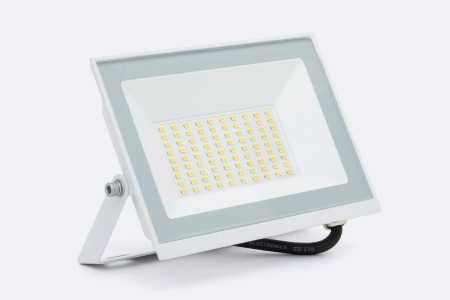
Shop Now – Envirolight Eco 50W LED Floodlight
The best professional floodlight
For larger commercial areas that need quality and sustained output, the Crompton Atlas Plus sits squarely in that category.
Its higher wattage and substantial heat-sinking make it suitable for larger areas where sustained performance matters. The 4000K colour gives clear, neutral white light that’s good for tasks and safety, while the solid housing and mounting options support pole and trunnion installations.
This is a professional‑grade choice designed for heavier duty use and easier maintenance planning.
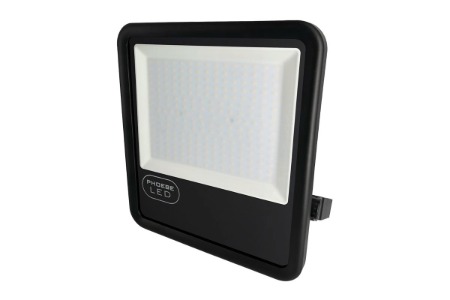
Shop Now – Crompton Atlas Plus 165W LED Floodlight
The best sensor floodlight
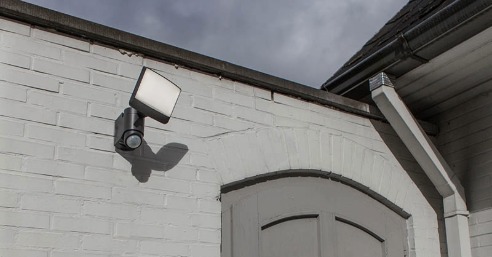
If you want security and connectivity in one device, the LEDVANCE Smart Wi‑Fi sensor floodlight brings a lot to a domestic set‑up.
It combines a compact warm‑white LED source with an integrated motion sensor and a camera, plus Wi‑Fi control so you can view alerts and adjust settings from a phone.
At around 15W it’s energy efficient yet bright enough for entrances and small yards, and the IP44 rating suits typical sheltered exterior mounting.
This is a top recommendation where live monitoring, simple app control and an all‑in‑one sensor camera solution are priorities.
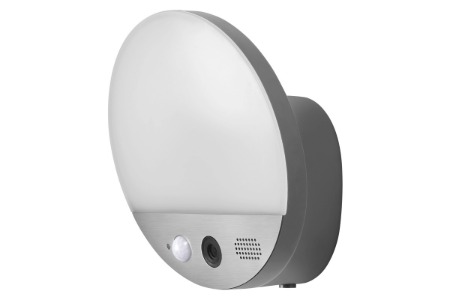
Shop Now – LEDVANCE Smart Wi‑Fi 15W Sensor Floodlight with Camera
The best solar floodlight
For locations where running mains cable is impractical, the Lutec Sunshine solar floodlight is a clever, self‑contained choice.
It combines an 8W LED with an external solar panel (including a 5m cable) and rechargeable battery, delivering about 500 lumens of daylight‑white light and a PIR sensor with an 18m, 180° detection zone.
IP44 protection and 30 to 120 second trigger periods make it well suited to decking, gates and remote outbuildings. Position the panel in a sunny spot and the unit gives a neat, cable‑free security light that’s easy to install.
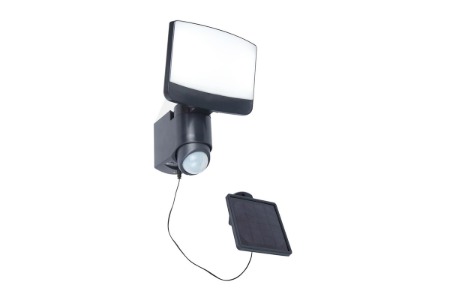
Shop Now – Lutec Sunshine 8W LED Solar Floodlight with PIR sensor
Shop quality floodlights at Lyco
Now that we’ve covered what you need to know about floodlights, it’s time to dive in. At Lyco, we have a wide range of security lighting to suit your needs.
We are the UK’s premier lighting company, providing the latest products from around the world at the very best prices. We are able to dispatch 98% of all orders on the same day they are received.
If you want to know more about our products and services, our team have the knowledge to assist you. Contact us today to learn more.
Shop floodlights at Lyco today
For more news, information, buying guides, and product advice, check out the Lyco blog…
How Light Works: The Ultimate Guide | Driveway Lighting Tips For Hospitality Venues | IP44 Lighting For Outdoors – Our Top 10
Related Articles

How Much Do Floodlights Cost to Run?
Floodlights do a simple, yet important job turning dark spaces into usable, safe, visible areas. Found anywhere from sports pitches and car parks, to building facades and gardens, floodlights by [...]
How Light Works: The Ultimate Guide
When you’re starting to choose lighting for your home, it can be tough to know where to begin, even if you’re certain of the style you’re looking to create in [...]
Light Fittings Types – Traditional Light Bulbs
When we think of a light bulb, we used to refer to an incandescent or tungsten filament lamp with a round sphere at one end or a candle lamp that [...]


 The
The