
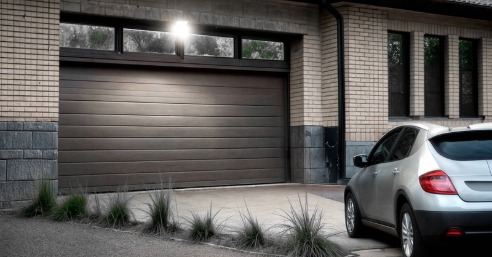
Floodlights do a simple, yet important job turning dark spaces into usable, safe, visible areas.
Found anywhere from sports pitches and car parks, to building facades and gardens, floodlights by their design need to be usable outside for long periods, making the issue of energy consumption a concern for many.
In this article, we’ll look at the true cost of running floodlights, so whether you are looking to illuminate your property, or work out those hidden costs of your existing equipment, you can be in the know. Keep reading to learn more…
What affects the running cost of a floodlight?
Before we start working out the running cost of a floodlight, it helps to know the things that push the price up or down:
- Wattage – how many watts the lamp uses
- Hours used – whether lights run for a few minutes at night, several hours, or for long sports sessions
- Electricity price – the pence per kWh on your bill. Domestic and commercial rates differ
- Number of fixtures – one light vs several makes a big difference
- Controls – timers, motion sensors, and dimmers reduce actual on-time
- Lamp efficiency and age – older lamps lose brightness and need replacing or higher wattage to give the same light
- Local tariffs and standing charges – these don’t change the per-hour cost but affect the total bill
Keep those in mind as they’ll determine whether a floodlight is a tiny cost or a noticeable monthly item.
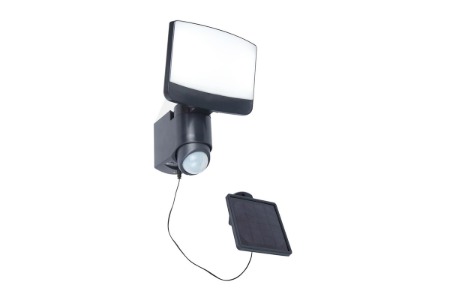
Shop Now – Solar Floodlights
How to calculate floodlight energy consumption
Understanding the running costs of a floodlight is a multiplication of power, time, and price. So to get a reliable estimate, we can use this formula:
Cost = (Wattage ÷ 1000) × hours used × unit price per kWh × number of lights
In the UK, under the current Energy Price Cap (as of October 2025), is an average of 26.35p per kWh.
Put the wattage in watts, convert pence to pounds for the unit price (26.35p/kWh = £0.2635), and the result is the cost for the period you used in “hours”. Multiply daily cost by 30 for a month or by 365 for a year, or calculate per session for event‑based lighting.
Let’s think about this with some examples.
If you had a single domestic LED floodlight of 20 W on for four hours each night, you would convert watts to kilowatts (0.02 kW), multiply by 4 hours and £0.2635, and you get about £0.021 a night. Over a month, that’s roughly £0.63 and around £7.70 a year.
Maybe you have a home security cluster of four 50 W LEDs with a motion sensor. This is best judged by average on‑time rather than full hours. If those floodlights average half an hour of operation per night between activations, the nightly cost works out at roughly £0.026, monthly about £0.79 and yearly about £9.60.
But what if you need to illuminate a small sports pitch, and are using older metal‑halide lamps? Eight fittings at 1,500 W each running three hours per session and two sessions a week add up quickly. The weekly cost comes to about £18.97, which is roughly £82 a month and about £987 a year.
The point to understand from these examples is that there are plenty of deciding factors that determine how expensive a floodlight can be to run. But as a general guide, these are quick UK‑oriented ranges give a sense of scale:
- Domestic garden/security lights – single LEDs and low hourly usage typically means a few pence to a few pounds a month
- Small shops or business fronts – several LED fittings running most evenings adds up to tens of pounds a month
- Community sports or large external installations – the regular, high power sessions translates to low hundreds to high hundreds a month, depending on hours and frequency
To calculate your own cost, find the wattage of each floodlight by checking the fitting, driver, or spec sheet. If the wattage isn’t obvious, look up the product code online or use a plug‑in power meter for portable units. For permanently wired fittings, the driver or ballast label usually gives the information you need.
Plug values into the formula above to get daily, monthly and annual figures. If you have motion sensors or timers, use expected average on‑time rather than assumed full hours to reflect real behaviour.
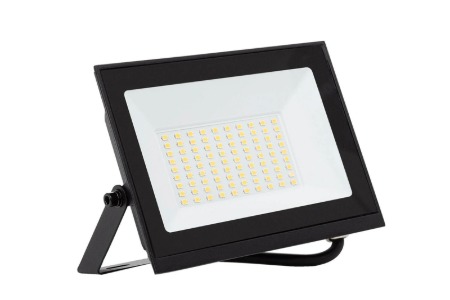
Shop Now – Residential Floodlights
How to save money with floodlights
The security value of a floodlight makes the monetary costs a necessary evil, but that doesn’t mean there aren’t ways to bring down those electricity bills:
Switching to LEDs and adding control systems
Switching to modern LED floodlighting is the most reliable way to reduce running costs. LEDs convert more electrical input into usable light per watt and, crucially for venues, allow refined control of output levels per fixture, often cutting energy by anything between roughly 50% and 80% for the same usable output.
Controls also help. Motion sensors (PIR) switch lights on only when activity is detected. Typical external PIR units offer wide coverage, often around 140 degrees and up to 12 metres, and adjustable on‑times from a few seconds to several minutes. For a domestic security light, that means the lamp only comes on when needed, rather than burning all night.
Timers let you set the hours lights are permitted to operate. If you only need lights at the most useful times, timers ensure they are off when they are not needed.
Advanced control systems add remote operation, lux‑level control and scheduled scenes. They are ideal where you want staged lighting for events or where natural light can be used to reduce artificial lighting.
Dimmable LEDs provide large savings in installations like sports training where full illumination is only occasionally necessary. Most modern fittings draw no meaningful power when off, though some older electronic control gear can have a small standby load.
Start with the highest‑impact, lowest‑hassle changes. Replace old lamps with decent quality LEDs and fit motion sensors on security lights.
For businesses and clubs, smart scheduling and a staged retrofit spread the cost while delivering steady savings. A lighting audit that checks hours, lux levels and distribution will reveal over‑lighting and unnecessary fittings to remove.
Solar floodlights can remove grid running costs entirely for some garden locations, though they come with higher upfront cost and variable winter performance.
Small wins include cleaning lenses and removing obstructions that reduce effective output.
Maintenance, depreciation and hidden costs
Regular maintenance can keep a floodlighting installation performing well and can directly affect running costs.
Dirt, insect build‑up and weathering reduce the amount of light that actually reaches the ground, so fixtures are often run longer or upgraded to higher wattage to compensate. Cleaning lenses and reflectors annually (or more often in coastal or dusty areas) can recover a surprising amount of lost output and delay replacements.
Replacing degraded gaskets and checking seals prevents water ingress that can damage drivers and LEDs, which otherwise creates an expensive unscheduled replacement.
Lighting depreciation is another quiet cost. Lamps and LED modules lose lumen output over time, which is why manufacturers quote useful life in L70 or L90 terms (the hours before output drops to 70% or 90% of initial levels).
When output drops, you either accept reduced lux levels or increase running hours or wattage to maintain the same visibility.
Budgeting for the occasional module replacement is sensible for commercial sites and sports clubs to avoid unexpected spikes in both replacement and running costs.
Finally, check ancillary items. Timers, control gear and photocells can fail or drift, causing lights to run longer than intended. A simple quarterly check of controls reduces the chance of a stray faulty sensor leaving lights on all night.
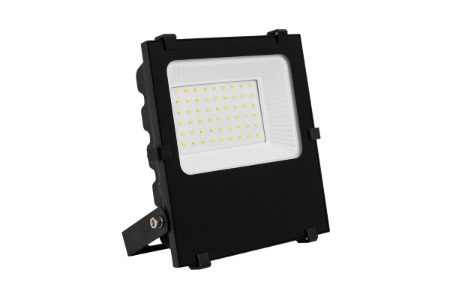
Shop Now – Professional Floodlights
Lyco: the home of outdoor lighting
We hope that you have found this guide to understanding the cost of floodlights useful. At Lyco, we have a wide range of security lighting to suit your needs.
We are the UK’s premier lighting company, providing the latest products from around the world at the very best prices. We are able to dispatch 98% of all orders on the same day they are received.
If you want to know more about our products and services, our team have the knowledge to assist you. Contact us today to learn more.
Shop floodlights at Lyco today
For more news, information, buying guides, and product advice, check out the Lyco blog…
How Light Works: The Ultimate Guide | Driveway Lighting Tips For Hospitality Venues | IP44 Lighting For Outdoors – Our Top 10
Related Articles

Floodlights: The Ultimate Buying Guide
Floodlights are simple in purpose but varied in design and application. A one‑size‑fits‑all approach rarely delivers the right light quality and efficiency to make it a suitable purchase, so if [...]
How Light Works: The Ultimate Guide
When you’re starting to choose lighting for your home, it can be tough to know where to begin, even if you’re certain of the style you’re looking to create in [...]
Light Fittings Types – Traditional Light Bulbs
When we think of a light bulb, we used to refer to an incandescent or tungsten filament lamp with a round sphere at one end or a candle lamp that [...]