
Halogen lighting has become very popular over the last fifty years. Halogen and Energy Saving Halogen bulbs offer a completely different set of features to other forms of lighting.
How halogen bulbs work
Halogen bulbs are a type of incandescent bulb and just like an incandescent use a tungsten filament. However, unlike the incandescent, the filament on the halogen bulb is enclosed by a small heat-resistant quartz or hard glass envelope. This envelope is filled with a halogen gas, which returns evaporated tungsten back onto the filament, increasing lifespan. This regenerative process is called the ‘halogen cycle’. A halogen bulb filament is hotter than that of an incandescent bulb, usually at 3000K.
A relatively large bulb such as a halogen GLS is essentially a ‘bulb within a bulb’, with the quartz envelope enclosed by a further glass casing. Smaller bulbs such as halogen capsules need especially careful handling, as they have no exterior cover and glass contamination causes premature failure.
Energy-saving halogen bulbs
Original halogen lighting is only fractionally more energy-efficient than incandescent. However, newer energy-saving halogen bulbs generally use 20-30% fewer watts than incandescent or standard halogen equivalents. This is achieved in two ways:
- Premium-fill gases like xenon or krypton are used instead of argon, causing the filament to burn more brightly and reducing required power for identical output.
- An IR reflective coating on the halogen quartz envelope bounces infrared heat back onto the filament, again causing it to burn more brightly for the same wattage.
Incandescent replacement
Energy-saving halogen technology is widely used in retrofit products for replacing incandescent bulbs, many of which have been phased out recently by EU legislation. It produces a marginally cooler, brighter-looking light than the old technology, and is better than incandescent light at rendering short wavelength colours (i.e. violets and blues).
Energy-saving halogen bulbs are available as an economical alternative to incandescent GLS bulbs, candles, ‘R’ reflectors, globes and golf balls. Halogen typically has twice the lifespan of an incandescent equivalent.
Halogen spotlights – mains-voltage GU10 & GZ10
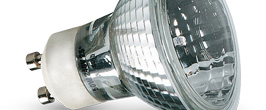
Halogen is one of the primary technologies used in spotlighting, partly due to the fantastic choice of products available. Another reason for its popularity is its superb colour rendering. A halogen bulb includes all colours of the visible spectrum in its light, which means colour is displayed with more consistency than is possible in LED or fluorescent technologies.
The GU10 spotlight is by far the most common type of mains-voltage halogen reflector. It is used in accent lighting, task lighting, and general lighting. GU10 bulbs use what is known as a ‘twist and lock’ base, introduced by Sylvania in 1996. The base provides a very secure electrical contact, similar in principle to a bayonet cap.
One defining factor in a GU10 is that IR heat is always projected forward in the beam, whereas many MR16 low-voltage bulbs of the same size (50mm diameter) use a dichroic filter to dissipate heat through the back of the bulb.
The GZ10 bulb is a relatively rare mains-voltage bulb that dissipates its heat using a dichroic filter through the back of the bulb. The GZ10 is unsuitable for use in most GU10 light fittings, and despite having the same pin arrangement it should not theoretically fit (a GU10 bulb has a bevelled base, whilst the GZ10 is squared). Light fittings normally carry a ‘no cool beam’ symbol to signify incompatibility with the GZ10.
Halogen spotlights – low voltage AR111, MR8, MR11 & MR16
Halogen AR111 spotlights are often used in shops or showrooms, and normally have a metal block over their filament to prevent glare.
The massively popular MR16 is universally loved by specifiers, partly for its wide variety of designs and beam angles.
Low-voltage spotlights are available with an aluminium-coated reflector, which projects IR heat forwards, or with a dichroic filter that allows IR heat to pass through the back of the lamp. A dichroic spotlight is useful for displaying heat-sensitive objects like food, artworks, or textiles.
Another advantage of low-voltage spotlights is their sharper, brighter quality of light over mains-voltage counterparts. In addition to display lighting, LV halogen spotlights are common in downlights and wire lighting systems.

Halogen low-voltage spotlights use the following caps:
- AR111 = G53
- MR8 and MR11 = GU4
- MR16 = GU5.3
All halogen low-voltage lamps require a 12V transformer, which is used to step down mains voltage to individual or multiple LV bulbs, dependent on maximum load.
Linear Halogens
Linear halogen lamps with R7s bases are found in floodlighting and security lights. The filament of the lamp is supported along its complete length, and the round bases at either end fit into sprung contacts. The filament must remain horizontal to maintain lifespan.
Specialist halogen R7s heat lamps include jacketed and non-jacketed versions. Jacketed lamps tend to last longer, since they’re protected from contaminants such as food.
Heat lamps are available in clear, ruby, or gold finishes. A clear finish is used where the bright white light of halogen is required in addition to heat. Ruby or gold finishes subdue light output for applications where heat is predominantly needed.
Capsules
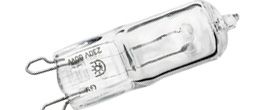
Halogen capsules are used in applications such as caravan lighting, boat lighting, pelmet lighting, or desk lighting. They come in low-voltage G4 or GY6.35 types, or a mains voltage G9 format. The suffixed numbers in their names are based on the distance in millimetres between their two pin centres.
The G9 is the most compact mains-voltage halogen bulb available, and because it requires no 12V transformer it’s widely used in extremely small light fittings.
High-powered specialist halogen capsules are also available for applications such as theatre, TV, film, or projector lighting.
Take a look at our range of light bulbs.
Looking for more news, information and advice? Try our Lighting Advice section.

Andrew is an experienced buying professional who takes an entrepreneurial approach to identify new lighting solutions and ensure Lyco have first-to-market ranges for our customers. Having previously worked for well known brands such as Wickes, Carphone Warehouse and Toys R Us, Andrew has now turned his hand to sourcing commercial lighting and ensure our customers receive top brand quality products at marketing leading prices. He manages a team of commercial and decorative buyers who travel the world finding new products that our customers don’t even know they need yet.
Related Articles

How Light Works: The Ultimate Guide
When you’re starting to choose lighting for your home, it can be tough to know where to begin, even if you’re certain of the style you’re looking to create in [...]
Light Fittings Types – Traditional Light Bulbs
When we think of a light bulb, we used to refer to an incandescent or tungsten filament lamp with a round sphere at one end or a candle lamp that [...]
Buying Guides – Outdoor Lighting
The outdoor lighting guide provides you with information on what to consider when deciding on an effective outdoor lighting scheme that meets your requirements. [...]